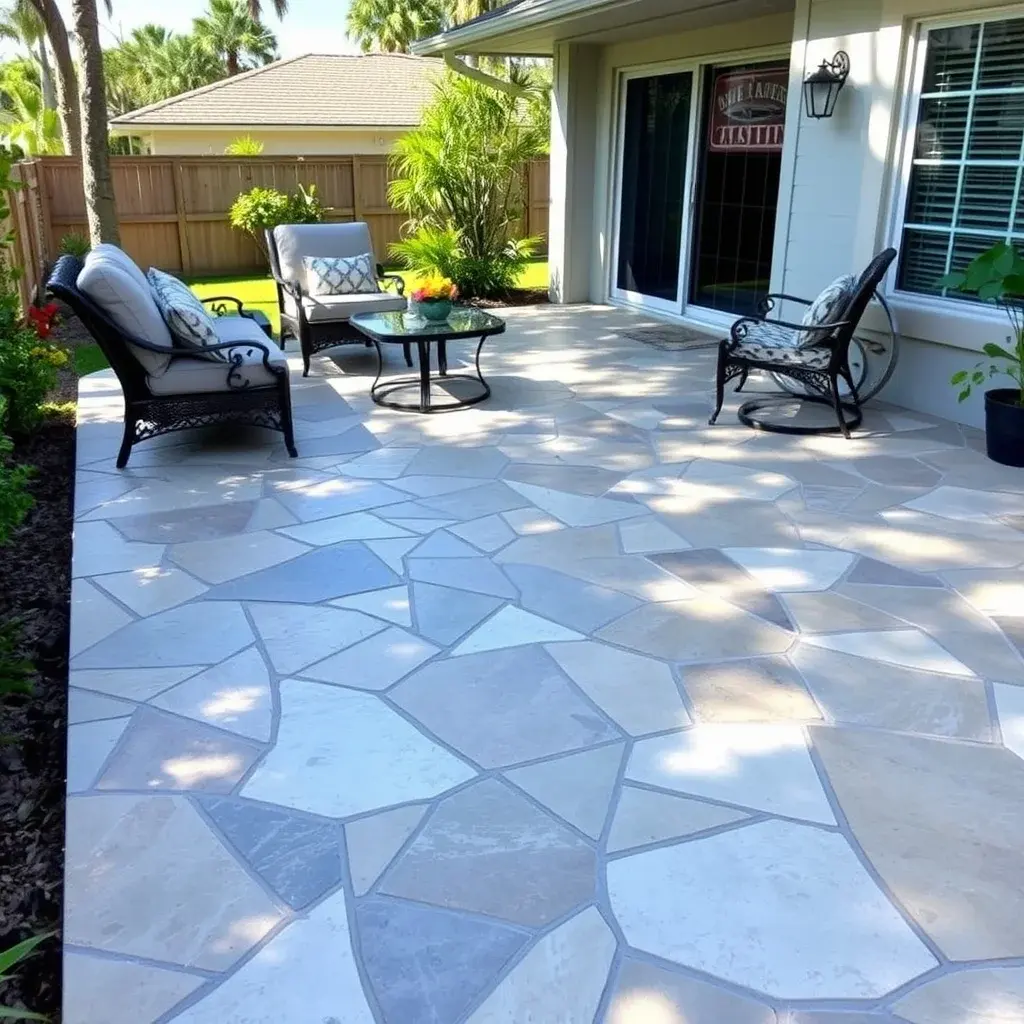
Stamped Concrete Patios: Cost, Patterns, and Design
Last updated 2026-07-30
Stamped concrete gives you the look of stone, brick, or tile at a lower cost than the real thing. A concrete slab is poured and then imprinted with texture stamps before it sets, creating a pattern that mimics natural materials. It is the most affordable way to get a textured patio surface, and it is the most customizable — you choose the pattern, the color, and the finish. Here is what stamped concrete costs, how it is installed, and how it compares to other patio materials.
What Is Stamped Concrete
Stamped concrete is a standard concrete slab with a textured pattern pressed into the surface before it cures. After the concrete is poured and leveled, polyurethane stamps are pressed into the still-wet surface to imprint a pattern — stone texture, brick, tile, slate, flagstone, or wood grain. Color is added either integrally (mixed into the concrete) or as a surface-applied stain and release agent that creates natural color variation between the high and low points of the texture.
The result looks like the material it mimics from a distance. Up close, the texture is less deep than real stone and the pattern repeats on a grid — most stamp mats are 2 to 4 feet square. Stamped concrete is an aesthetic compromise: it looks 80 percent as good as natural stone for 50 percent of the cost.
How Much Does Stamped Concrete Cost
Stamped concrete costs $8 to $18 per square foot installed for standard patterns — basic single-color starts at $8–$12, while premium multi-stamp with borders runs $15–$18. A 400-square-foot stamped concrete patio costs $4,800 to $7,200.
| Pattern Complexity | Cost per Sq Ft (Installed) |
|---|---|
| Basic (single stamp, one color) | $8–$12 |
| Standard (stone/brick, integral color) | $12–$15 |
| Premium (multi-stamp, borders, stains) | $15–$18 |
| High-end (custom stamps, acid stain) | $18–$25 |
A 400-square-foot patio with a standard stone pattern and integral color costs $4,800 to $6,000. The same patio in premium multi-stamp with borders costs $6,000 to $7,200. Compare that to pavers at $12 to $22 per square foot and travertine at $15 to $30 — stamped concrete is consistently the most affordable textured option.
Pattern and Color Options
The pattern is limited by the stamp mats your contractor owns. Most contractors carry 4 to 8 stamp patterns — ashlar slate, running bond brick, random stone, herringbone brick, and wood plank are the most common. Borders and accent bands use smaller stamps to create contrast around the edge.
Color is applied in two ways. Integral color — pigment mixed into the concrete — produces a uniform base color that runs through the entire slab. Surface color — a powdered release agent and stain applied during stamping — creates the natural variation and highlights the texture. Most installations use both: an integral color close to the desired tone, and a contrasting release agent that settles into the low points of the texture.
Installation Process
Excavation and base preparation come first — 4 to 6 inches of compacted gravel for drainage, the same as any concrete slab. The concrete is poured at 4 inches thick for patios. Stamping happens immediately after the pour, while the concrete is still plastic but firm enough to hold an impression. The crew works in sections, stamping before the concrete sets beyond the working window — timing is critical, and an experienced crew is the difference between clean impressions and blurred patterns.
After stamping, the concrete cures for 7 days. A sealant is applied to protect the surface and enhance the color. The patio is ready for furniture after the sealant dries — typically 1 to 2 days after sealing.
Sealing and Maintenance
Sealing is not optional with stamped concrete. The sealer protects the color from UV fading, fills microscopic pores in the concrete, and creates a barrier against stains. Reseal every 2 to 3 years — more often in sunny climates where UV degrades the sealer faster. A gallon of sealer costs $50 to $100 and covers 200 to 300 square feet. Professional sealing costs $1 to $2 per square foot.
Cracks in stamped concrete are more visible than in plain concrete because they cut across the pattern. A crack that follows a control joint is normal and expected — the joint is there to guide the crack. A crack that runs randomly across the slab indicates a base preparation or curing problem. Small cracks can be filled with color-matched caulk. Large cracks that disrupt the pattern cannot be invisibly repaired — the entire section may need replacement, and the new concrete will not match the aged color of the surrounding slab.
Stamped Concrete vs Pavers vs Flagstone
Stamped concrete is the most affordable textured option at $8 to $18 per square foot. Pavers cost $12 to $22 per square foot but are individually replaceable — if a paver cracks, you lift it out and drop in a new one. With stamped concrete, repairs are visible.
Flagstone is the real natural stone that stamped concrete mimics. It costs $15 to $30 per square foot and has genuine depth, texture, and color variation that stamps cannot fully replicate. If budget allows, flagstone is the authentic version of what stamped concrete approximates.
Frequently Asked Questions
How long does stamped concrete last?
Twenty to 30 years with proper sealing and maintenance. The concrete itself lasts as long as any concrete slab — decades. The surface appearance depends on sealing: a well-sealed stamped patio looks good for 15 to 20 years before the texture wears smooth and the color fades. A neglected patio with no sealer shows wear in 5 to 8 years.Is stamped concrete slippery when wet?
It can be. The texture helps — the impressions create a slightly uneven surface that provides more grip than smooth concrete. But sealed stamped concrete can be slick, especially around pools. A non-slip additive mixed into the sealer provides grip without changing the appearance.Can stamped concrete be repaired?
Small cracks can be filled with color-matched caulk. Large cracks or spalled areas cannot be invisibly repaired — the patch will have a different color and texture than the surrounding slab. This is the tradeoff of stamped concrete: it costs less upfront than pavers but repairs are more visible.Does stamped concrete increase home value?
It increases curb appeal and usable outdoor space more than it directly adds to resale value. A well-maintained stamped concrete patio is an asset during showings — it reads as a finished outdoor living area rather than a bare concrete pad. But it does not add dollar value the way a kitchen renovation or additional square footage does.Stamped Concrete Patio Installers in Your Area
Our partnered contractors handle stamped concrete patios across Central and Western Florida:
- The Villages: Stamped concrete patio installation in The Villages
- Central Florida: Clermont patio installation · Gainesville patio installation
- Tampa Bay Coast: Clearwater patio installation · Largo patio installation
Compare patio types: Paver patios · Travertine patios · Flagstone patios
Ready to Build Your Stamped Concrete Patio?
We connect you with up to three licensed concrete contractors. Free estimates, no obligation. Call (352) 555-0194 or visit our patio installation services page.
Related reading: Paver Patios · Travertine Patios · Flagstone Patios · Patio Installation